Sleep · Mattresses
Best Mattress for Back Pain (2026)
Wake up pain-free. We compared firmness, lumbar support and pressure relief across top hybrids to find the best mattresses for back pain.
Read Review
| Product | Best For | Key Feature | Price Range | |
|---|---|---|---|---|
 Saatva Mattress Topper | Best topper for back pain overall | Talalay latex, 1.5 or 3 in, 180-night trial, 1-year warranty | $295–$650 | Check Price on Amazon |
 Tempur-Pedic TEMPUR-Adapt Topper | Best memory foam topper for back pain | 3 in TEMPUR-Material, washable cover, 10-year warranty | $270–$410 | Check Price on Amazon |
 Helix Plush Mattress Topper | Best budget topper for back pain | 1.5 in fibre-fill, machine washable, hypoallergenic | $110–$150 | Check Price on Amazon |
Prices are ranges at time of writing and change frequently — check Amazon for the current price.
We compared manufacturer specifications, independent review testing and verified buyer feedback across the mattress topper market, weighting pressure relief and spinal support (35%), material quality and durability (25%), thickness and fit (20%) and trial, warranty and value (20%). This is a research-based comparison of specs and published test results, not a hands-on test. The most important thing to understand before buying a topper for back pain is what a topper can and cannot do. A topper changes the surface of the bed, not the support underneath it. If your mattress is too firm and your back hurts because pressure builds at the hips and shoulders, a topper adds the cushioning layer that is missing, and the pain often eases within a week. If your mattress sags in the middle, a topper will follow the sag — it cannot compensate for a broken support core, replace broken coils, or fix structural indentations deeper than about 1.5 inches. In that case the honest answer is a new mattress, and our best mattress for back pain guide is the right place to start instead.
Material is the second decision, and it matters more than brand. Talalay latex is naturally responsive and bouncy: it pushes back against the body, keeps the hips elevated, and sleeps cool, which is why it suits back sleepers best. Memory foam contours closely and relieves pressure points by spreading weight, but it sleeps warmer and responds more slowly. Fibre-fill is the softest and cheapest option: it adds plushness and a quilted feel, but it offers the least support and flattens fastest. Thickness is the third decision. A 3-inch topper changes the feel of the bed significantly; a 1.5-inch topper corrects a bed that is nearly right. Anything under 1.5 inches is mostly cosmetic. If your back pain comes with a mattress that is also too warm, our best mattress for hot sleepers guide covers cooling options that pair well with a latex topper.
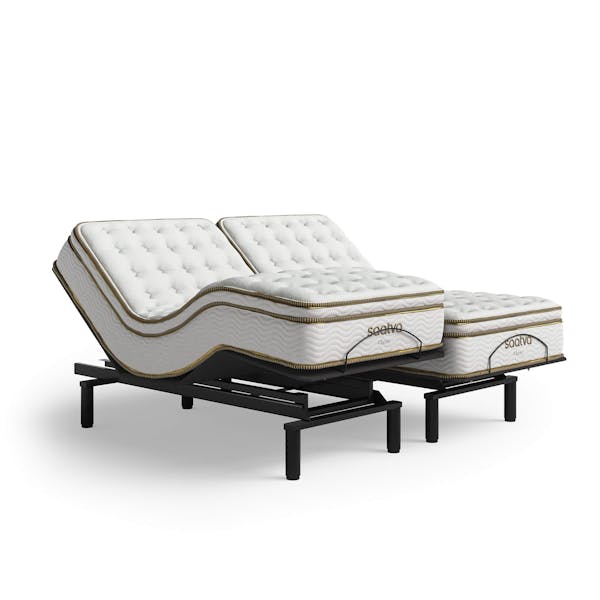
The Saatva Mattress Topper is the most versatile pick because it is really three toppers in one line. Saatva sells a graphite-infused memory foam version (3 inches, medium-firm), a Talalay latex version (1.5 or 3 inches, medium-firm) and a high-density foam version, all with organic cotton blend covers treated with a botanical antimicrobial finish. For back pain, the latex version is the one to buy: reviewers and the brand itself describe it as the best option for back sleepers, because the responsive latex keeps the hips elevated enough for the back to lie flat, and the pressure relief covers the lower back, shoulders and hips. A queen latex topper costs around $445, with prices from about $295 for a twin to $650 for a split king, and every Saatva topper comes with a 180-night trial, a 1-year warranty and free white-glove delivery. The graphite memory foam version is the better choice if you want deeper contouring and pressure relief at a lower price — a queen runs around $295–$345 — though reviewers note it can sleep warmer than the latex despite the graphite infusion.
The Tempur-Pedic TEMPUR-Adapt Topper is the premium memory foam option and the thickest pick here: 3 inches of proprietary TEMPUR-Material, the same pressure-relieving foam Tempur-Pedic puts in its mattresses, inside a removable high-stretch knit cover that zips off for machine washing. Tempur-Pedic describes it as an extra-soft topper built for personalised support that responds to your weight, shape and temperature, and independent reviewers rate it medium (5 out of 10) in firmness — most suitable for side and back sleepers under 230 lb. A queen costs around $349–$359, with twins from about $269 and kings to about $409, and a cooling-cover version adds roughly $80. It comes with StayTight corner straps that fit mattresses up to 13 inches deep, and a 10-year limited warranty — the longest warranty of the three picks. The catch is the return policy: Tempur-Pedic does not take returns on toppers unless the item arrives damaged or has a defect, so there is no trial period to hide behind. If you have never slept on TEMPUR-Material, that matters — memory foam's slow, sinking feel is something people either love or hate, and you cannot find out cheaply.
The Helix Plush Mattress Topper is the budget pick and the simplest one: a 1.5-inch quilted topper with a 100% polyester fibre-fill, a cover blended from 70% polyester and 30% bamboo rayon, and a fitted-sheet-style skirt that holds it to the mattress like a sheet. It is completely machine washable and hypoallergenic, which makes it the best choice for allergy sufferers, and it costs just $110–$150 depending on size. What it does well is soften a bed that is slightly too firm and add a plush, quilted surface — reviewers note it is a good choice for people who want a thin layer of plushness. What it does not do is provide the deep pressure relief or the hip support of the latex or memory foam picks, so it is the right buy for mild discomfort and for renters or guest rooms, not for serious back pain. If the topper route is not enough and you want a full sleep-system upgrade, our best adjustable bed frame guide covers bases that let you raise the head and feet, which many back-pain sufferers find helps as much as the mattress itself.
A mattress topper is a removable layer, usually 1.5 to 4 inches thick, that sits on top of your existing mattress and under your sheets. It is not a mattress: it has no support core of its own, and it relies on the mattress underneath for structure. Its job is to change the feel of the surface — softer, cooler, more contouring — without replacing the bed. For back pain, the mechanism is straightforward. Most back pain that is worse in the morning comes from the spine spending the night out of alignment: either the mattress is too firm and pressure builds at the shoulders and hips, forcing the lower back to arch, or it is too soft and the hips sink, which arches the lower back the other way. A topper corrects the first problem well and the second problem partially. A latex or memory foam topper on a too-firm mattress adds the give that lets the shoulders and hips settle, so the spine rests neutral. On a too-soft mattress, a firmer topper can add a little pushback, but it cannot fix a sagging core.
The other thing a topper does is buy time. A good mattress costs $1,000 or more, and a topper costs $110–$450 — so if your mattress is basically sound but the comfort layer has worn thin, a topper extends its useful life by a year or two for a tenth of the price. That is the right way to think about it: a topper is a precision tool for a specific problem, not a band-aid for a broken mattress. It also helps to know that back pain has many causes, and a topper only addresses the sleep-surface ones. If your pain is sharp, radiates down a leg, or does not change with the bed, see a clinician rather than shopping for bedding. And if you are a side sleeper whose back pain comes from shoulder pressure, our best mattress for side sleepers guide covers the pressure-relief side of the same problem in more depth.
Yes, if the pain comes from a mattress that is too firm or has lost its comfort layer. A topper adds pressure relief and lets the spine rest in a neutral line. But a topper cannot fix a sagging support core or indentations deeper than about 1.5 inches — if the mattress itself has failed, a topper only delays the replacement.
Responsive materials work best: Talalay latex and high-density memory foam. Latex pushes back and keeps the hips elevated, which suits back sleepers. Memory foam like TEMPUR-Material contours closely and relieves pressure points. Soft fibre-fill toppers add cushioning but little support, so they are the weakest choice for back pain.
Three inches is the sweet spot for back pain. A 3-inch topper like the TEMPUR-Adapt or the Saatva Graphite changes the feel of the bed enough to relieve pressure without letting the hips sink. A 1.5-inch latex topper works when the mattress is nearly right and only needs a small correction. Anything under 1.5 inches is mostly cosmetic.
Yes. The Saatva latex topper is widely recommended for back pain because Talalay latex is responsive, pressure-relieving and breathable. It comes in 1.5-inch and 3-inch options, suits back sleepers best because the hips stay elevated, and it comes with a 180-night trial and a 1-year warranty.
Buy the Saatva latex topper if you want the best all-round topper for back pain: responsive latex, real pressure relief, a 180-night trial and a price that stays under $500 for a queen. Buy the TEMPUR-Adapt if you love the slow, contouring feel of memory foam and want the deepest pressure relief available in a topper — just be sure you have slept on TEMPUR-Material before, because there is no trial. Buy the Helix Plush if your budget is tight, your mattress is only slightly too firm, or you need a washable, hypoallergenic topper for a guest room. And before you order any of them, check the mattress underneath: if it sags, no topper will save it, and the money is better spent on a new bed.
Sleep · Mattresses
Wake up pain-free. We compared firmness, lumbar support and pressure relief across top hybrids to find the best mattresses for back pain.
Read ReviewSleep · Bed Frames
Raise your head, lift your feet, sleep better. We compared motors, weight capacity, massage and zero-gravity features to find the best adjustable bases.
Read ReviewSleep · Mattresses
Side sleepers need pressure relief at the shoulders and hips. We compared the best mattresses for side sleeping — comfort, support and cooling.
Read Review