Home Comfort · Climate
Best Space Heater for Large Rooms (2026) — Picks
The best space heater for large rooms in 2026: Dreo Solaris Max, Lasko tower and De'Longhi Dragon compared on heat output, safety and running costs.
Read Review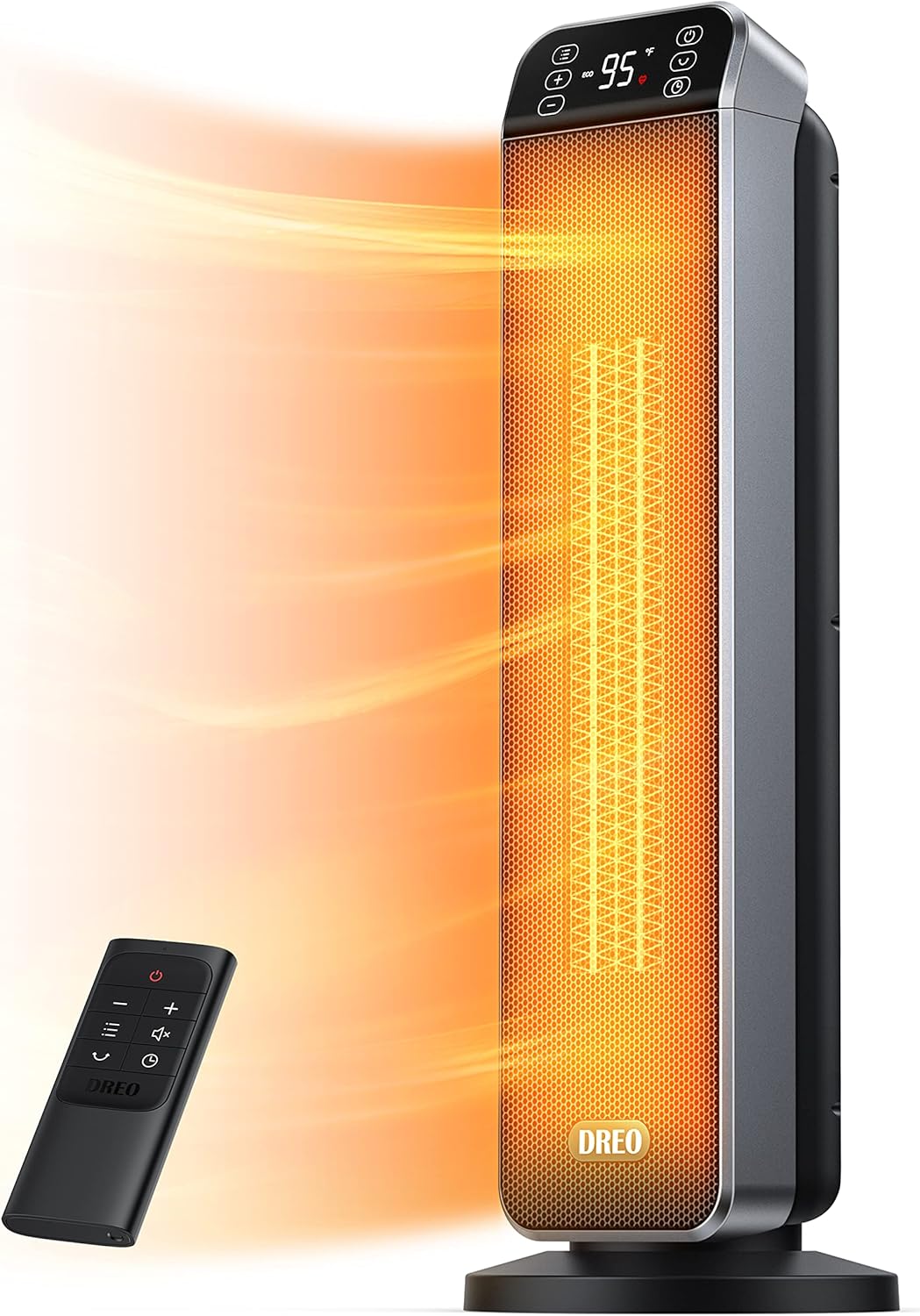
| Product | Best For | Key Feature | Price Range | |
|---|---|---|---|---|
| Dreo Solaris Max | Best overall for bedrooms | 1,500W ceramic, 70° oscillation, 41–95°F thermostat | $70–$110 | Check Price on Amazon |
 De'Longhi Dragon Digital TRD40615E | Best silent overnight heat | 1,500W oil-filled, digital thermostat, 24-hour timer | $100–$180 | Check Price on Amazon |
 Vornado AVH10 | Best even whole-room warmth | 1,500/750W vortex circulation, Auto Climate control | $80–$120 | Check Price on Amazon |
 Dyson Hot+Cool AM09 | Best premium year-round pick | Bladeless Jet Focus heat and cooling, sleep timer | $400–$500 | Check Price on Amazon |
Prices are ranges at time of writing and change frequently — check Amazon for the current price.
Our research is comparison-based: we did not test these heaters in a lab ourselves, so we compared manufacturer specifications, independent expert coverage and verified buyer feedback, and weighted the criteria that matter most in a bedroom. Quiet operation came first, because a heater you can hear all night is a heater you will switch off. Safety features came second — tip-over shutoff, overheat protection, a cool-touch exterior and certification by a recognized testing laboratory. Thermostat accuracy and a timer came third, because steady overnight temperature matters more than raw power in a bedroom. Finally we weighed heat output and value: every pick here is sized for a typical bedroom of roughly 100 to 300 square feet.
We deliberately covered the three heater types buyers actually choose between, so this guide works as a buying decision, not just a list. The Dreo and Dyson are fan-forced ceramic heaters, the De'Longhi is an oil-filled radiator, and the Vornado is a fan-forced vortex heater. If your bedroom is larger than 300 square feet, or open-plan, see our best space heater for large rooms guide instead — the picks there are sized for bigger spaces. And if dry winter air is part of the problem, pairing a heater with one of our best humidifiers for bedroom picks can make the room feel more comfortable at a lower temperature.
Every electric space heater turns electricity into heat at roughly the same efficiency — a 1,500-watt heater produces 1,500 watts of heat no matter the technology. What differs is how that heat reaches you, how fast it arrives, and how noisy the process is. Understanding the three main types makes the choice much easier.
Ceramic heaters pass air over electrically heated ceramic plates and blow the warm air out with a fan. They heat a room fast — the Dreo Solaris Max, for example, is marketed as delivering warmth within seconds — and they usually include a thermostat, oscillation and a remote. The trade-off is fan noise and moving air, which some sleepers find drying or distracting. Ceramic fan heaters are the best choice when you want a cold bedroom warm quickly before bed, and when you want precise temperature control.
Oil-filled radiators work very differently. An electric element heats diathermic oil sealed inside steel columns, and the hot columns warm the room by natural convection and radiant heat — with no fan at all. They are effectively silent, which is why the De'Longhi Dragon below is our pick for light sleepers. They heat slowly, taking 15 to 30 minutes to make a real difference, but they hold a steadier temperature once warm, because the oil keeps radiating heat even after the element cycles off. They are heavy — the De'Longhi weighs about 26.6 pounds — and their surfaces get hot to the touch, so they need clear space around them.
Infrared (radiant) heaters use quartz or carbon elements to emit infrared radiation, which warms people and objects directly rather than heating the air first — the same way sunlight feels warm on your skin. They are silent and give near-instant warmth in their line of sight, but they do little for the far side of a room and stop warming you the moment you step out of their beam. None of our four picks is an infrared heater, because for a whole bedroom, ceramic and oil-filled designs warm the air more evenly. Infrared makes sense mainly as a spot heater for a desk or reading chair.
One more practical point: almost every plug-in bedroom heater tops out at 1,500 watts, because that is close to the most a standard 15-amp household circuit can safely deliver. A heater advertised above 1,500 watts on a standard US plug is worth treating with suspicion. Running costs follow directly from wattage: a 1,500-watt heater uses 1.5 kilowatt-hours per hour, so at 17 cents per kilowatt-hour it costs about 26 cents per hour on high — roughly $2 for an eight-hour night if it ran at full power the whole time, though a thermostat will cycle it down once the room is warm.
The Dreo Solaris Max is our top pick for most bedrooms because it balances the three things that matter at night: fast heat, a precise thermostat and quiet operation. It is a 1,500-watt PTC ceramic tower heater with three heat settings — 700, 900 and 1,500 watts — plus an ECO mode, a thermostat adjustable in 1-degree steps from 41 to 95°F, a 1-to-12-hour timer and 70-degree oscillation. Its listed coverage is up to 270 square feet, which fits most bedrooms comfortably, and at 24 inches tall with a 7.8-inch-square footprint it tucks beside a bed or dresser without dominating the room.
What buyers report most often is how quickly it takes the chill off a cold room, and how useful the remote is from bed — you can adjust the temperature or switch it off without getting up. The thermostat is the feature that matters most overnight: instead of blasting heat until the room is too warm and then going cold, it holds the temperature you set. The Solaris Max also includes tip-over protection and overheat protection, and its display dims, which helps in a dark bedroom. The typical price range is $70–$110. The main trade-off is that it is a fan heater, so it is not silent — light sleepers who are very noise-sensitive may prefer the oil-filled De'Longhi below. If you want whole-home temperature control as well, our best smart thermostat for home guide covers that side of winter comfort.
If silence is your priority, the De'Longhi Dragon Digital TRD40615E is the pick. It is a 1,500-watt oil-filled radiator with a digital control panel, an electronic thermostat adjustable from 40 to 82°F, a 24-hour programmable timer, an ECO energy-saving function and three heat settings (600, 900 and 1,500 watts). There is no fan, so there is effectively no operating noise — the only sound is the occasional click of the thermostat. That makes it the natural choice for light sleepers, nurseries and anyone who has ever been kept awake by a fan.
The Dragon's strength is steady, gentle heat. Its sealed oil reservoir never needs refilling, and the oil's thermal mass smooths out temperature swings, so the room stays even rather than cycling hot and cold. The 24-hour timer is genuinely useful in a bedroom: you can program it to warm the room before you get into bed and ease off in the early morning. Safety features include a child lock and a thermal cut-off that switches the heater off if it overheats, plus an anti-freeze setting that turns it on automatically if the room drops below 44°F. The trade-offs are speed and weight: it takes time to warm a cold room, so switch it on well before bedtime, and at about 26.6 pounds it is not something you will carry from room to room every day — though its SmartSnap wheels help. The typical price range is $100–$180. For a small-to-medium bedroom where quiet, steady heat matters more than instant warmth, this is the best space heater for bedroom use in our research.
The Vornado AVH10 takes a different approach from the tower heaters: instead of blowing a stream of hot air in one direction, it uses what Vornado calls Vortex Heat Circulation to move warm air around the whole room, aiming for an even temperature with no hot spot near the heater and no cold corner by the window. It offers two heat settings — 1,500 watts on high and 750 watts on low — plus a fan-only mode for warmer months, push-button controls with a digital display, and Auto Climate Control, which automatically adjusts heat output and fan speed to hold your set temperature.
At 5.4 pounds and roughly 12 inches tall, it is compact and easy to move between rooms, and it carries a 5-year satisfaction guarantee from Vornado — the longest warranty of any pick here. Safety features include a cool-touch case, tip-over shutoff and an automatic safety shutoff system, and the 6-foot cord gives reasonable placement flexibility. Buyers report that it is quiet for a fan heater and that the even-heat claim holds up in small-to-medium rooms. The trade-offs: there is no oscillation and no remote, so you adjust it by walking over to it, and it does not deliver the intense blast of direct heat some people want right at their feet. The typical price range is $80–$120, and Vornado lists it at $99.99 on its own site. Choose the AVH10 if your bedroom has uneven temperatures — cold by the window, warm by the door — and you want the whole room at one comfortable level.
The Dyson Hot+Cool AM09 is the most expensive heater on this list by a wide margin, and it is the only one that earns its keep all year: it is a fan heater in winter and a cooling fan in summer, using Dyson's Air Multiplier technology and Jet Focus control to project air across the room. In heating mode, ceramic plates warm the air as it is projected; Jet Focus mode channels a concentrated stream for fast personal warmth, while Diffused mode spreads heat evenly through the room. It oscillates up to 70 degrees, offers 10 fan speeds, a thermostat up to 37°C (about 99°F) and a sleep timer that switches it off after 15 minutes to 9 hours — the most flexible overnight timer of any pick here.
The bladeless design is the AM09's real bedroom advantage: there are no fast-spinning blades and no visible heating elements, it is easy to clean, and it shuts off automatically if tipped over. It is also compact for a heater-fan combo at 23.43 inches tall and 5.91 pounds, with a magnetic remote that stores on the unit itself. Dyson lists it at $499.99, and it is currently shown as out of stock on Dyson's own site, so check availability before settling on it — the typical price range is $400–$500 when it is in stock. The honest case against it is value: it costs roughly five times the Dreo while delivering similar heating power, and it has no air purification, unlike Dyson's purifier models. Buy it if you want one premium device that heats in winter, cools in summer, looks good in a bedroom and is genuinely safe around children and pets — not if you only need heat for three months a year.
Safety deserves its own section, because a bedroom is where space heaters are most dangerous: you are asleep, the room is full of bedding and curtains, and nobody is watching the heater. The US Consumer Product Safety Commission estimates that portable heaters, including electric space heaters, are involved in an average of 1,600 fires per year, resulting in an average of 70 deaths and 150 injuries annually from 2020 to 2022. Those numbers are the reason every pick in this guide has tip-over shutoff and overheat protection — and the reason the habits below matter more than any feature.
First, keep the three-foot rule: the CPSC advises keeping portable heaters at least three feet away from drapes, furniture, bedding and other combustible materials, and placing the heater on a level, hard, nonflammable surface — not on rugs or carpets, and never near bedding or curtains. Second, plug the heater directly into a wall outlet — never into an extension cord or power strip — and check the plug and outlet occasionally during use; if they feel hot, switch the heater off and have an electrician inspect the outlet. Third, buy a heater certified by a nationally recognized testing laboratory, such as UL or ETL: certification means the heater has been tested to current safety standards, including tip-over cut-off. Fourth, check for recalls before you buy or use a heater, at cpsc.gov/recalls.
The most important rule for bedrooms is the one people most often ignore: the CPSC advises turning portable heaters off when sleeping, and never placing a space heater close to a sleeping person. The safest routine is to warm the bedroom before bed, then let a thermostat or timer take over — or switch the heater off entirely and rely on warm bedding. If you do run a heater overnight, use one with a programmable timer and thermostat, keep it three feet from the bed, keep children and pets away from it, and make sure you have working smoke alarms inside each bedroom and carbon monoxide alarms outside sleeping areas, tested monthly. No heater, however well designed, makes it safe to sleep beside bedding draped over it or a unit running on an extension cord.
There is no zero-risk space heater, but the safest bedroom choices are electric heaters with tip-over shutoff, overheat protection and a cool-touch exterior, certified by a nationally recognized testing laboratory such as UL or ETL. The CPSC advises keeping any heater at least three feet from bedding, drapes and furniture, plugging it directly into a wall outlet, and turning it off when you sleep or leave the room.
Most bedrooms are 100 to 300 square feet, and a standard 1,500-watt heater is sized for that range. The Dreo Solaris Max, for example, lists coverage of up to 270 square feet. Measure your room first: a heater rated well below your room size will run constantly and still leave cold corners, while an oversized heater cycles on and off and wastes electricity.
The CPSC advises turning portable heaters off when sleeping and never placing a heater close to a sleeping person. If you need overnight warmth, the safer approach is to warm the room before bed, then use a heater with a programmable timer and thermostat, such as the De'Longhi Dragon TRD40615E, so it shuts off or drops to a low setting while you sleep. Never run a heater unattended or on an extension cord.
Ceramic fan heaters such as the Dreo Solaris Max warm a room fast and are best when you want heat quickly before bed. Oil-filled radiators such as the De'Longhi Dragon heat more slowly but run silently and hold a steadier temperature overnight, which many light sleepers prefer. If noise bothers you, choose oil-filled; if you want fast warmth and a thermostat, choose ceramic.
For most bedrooms, the Dreo Solaris Max is the best space heater for bedroom use: fast 1,500-watt ceramic heat, a precise 41–95°F thermostat, a timer and remote, and a price of $70–$110 that undercuts the premium options by a wide margin. If you are a light sleeper, the De'Longhi Dragon TRD40615E is the better choice — silent, steady, and built for overnight use with its 24-hour timer. If your room heats unevenly, the Vornado AVH10's vortex circulation and Auto Climate control even it out for $80–$120. And if you want one device for the whole year, the Dyson Hot+Cool AM09 heats in winter and cools in summer — at $400–$500, a luxury, but a genuinely good one. Whichever you choose, measure your room, keep three feet of clear space around the heater, plug it straight into the wall, and warm the room before bed rather than running it all night beside you.
Home Comfort · Climate
The best space heater for large rooms in 2026: Dreo Solaris Max, Lasko tower and De'Longhi Dragon compared on heat output, safety and running costs.
Read ReviewHome Comfort · Air Quality
Quieter sleep, easier breathing. We compared tank size, runtime, mist type and smart controls to find the best bedroom humidifiers.
Read ReviewHome Comfort · Air Quality
The best air purifier for bedroom use in 2026: Levoit Core 400S, Coway Airmega 250S and Blueair 211i Max compared on CADR, noise and sleep mode.
Read Review